When parents first hear that school or kindergarten is bilingual, they often imagine a few hours of English a week. At Maple Bear, however, we approach language learning differently.
Our goal is not to teach English as a separate subject. We want to enable children to learn the language naturally – through everyday situations, games, discovery and communication. It is on this principle that the immersion method, one of the basic pillars of the Canadian educational model, is based.
What does the immersion method mean?
The word immersion means immersion. In education, it refers to an approach in which pupils are naturally exposed to a second language during normal activities and teaching. Instead of memorizing words or practicing grammar in isolation, they use language as a tool for communicating, learning about the world, and dealing with everyday situations. Just as a young child learns his mother tongue by hearing and using it constantly, they also learn English in an immersive environment. Language thus does not become the goal of teaching, but a natural part of it.
How does immersive teaching work in kindergarten?
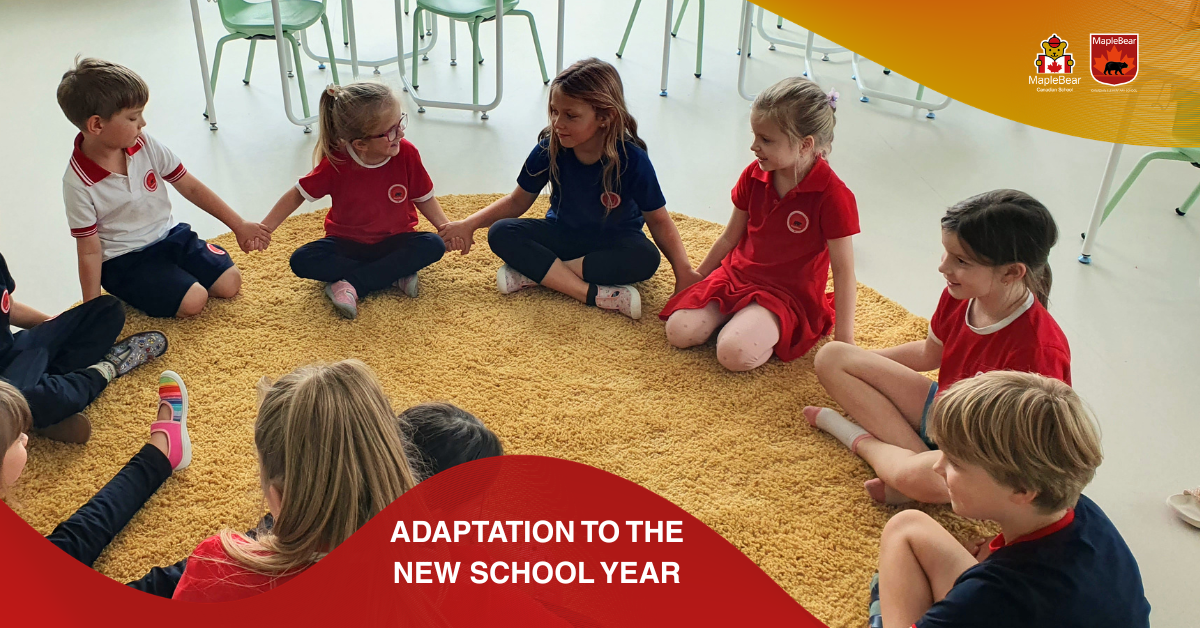
At Maple Bear Kindergarten, English is the main language of the program. Children encounter it during games, creation, physical activities, joint projects and everyday communication throughout the day.
Parents often wonder if their children will understand teachers, especially if they have not yet encountered English. The experience of more than twenty years of operation of Maple Bear schools around the world shows that they adapt to the environment very quickly. Teachers use a number of natural strategies to help understanding. They work with gestures, facial expressions, pictures, photographs, songs, rhymes, movement and play. They adjust the pace of speech, repeat important information and use different formulations of the same message.
As a result, children gradually acquire new vocabulary, language structures and correct pronunciation, often without the feeling that they are just learning a foreign language. Important news for parents: even preschoolers without previous knowledge of English are entering the program. The methodology is designed so that they can successfully participate and gradually acquire the language at their own pace.
At the same time, we do not forget about Czech. Part of the program is the Czech Centre, in which we systematically develop the Czech language and prepare future pupils for further education in the Czech environment.
How does immersion continue in elementary school?
Bilingual education continues to develop at primary school. Most subjects are taught bilingually and each class is led by a Czech and English-speaking teacher. Both teachers plan the lessons together and build on each other so that the pupils naturally use both languages throughout the day. Czech and English do not represent two separate worlds here. They are becoming common tools for communication, thinking and acquiring new knowledge.
Learning Centres are also an important part of our methodology, where pupils work independently and in groups, discuss, solve problems and actively discover new contexts. Language is not an end here, but a means to learn.
Why is the immersion method so successful?
The Canadian model of bilingual education has long been considered one of the most successful in the world. A number of studies show that bilingual education can bring benefits to children that go beyond mere knowledge of a second language. Children growing up in a bilingual environment often develop skills related to concentration, problem-solving, flexible thinking, or switching between different tasks effectively. At the same time, regular work with two languages supports brain development and the ability to process information effectively.
Moreover, the benefits of bilingualism do not end at the school desks. In a globalized world, knowing multiple languages is an increasing advantage. Employers value not only language skills, but also adaptability, cultural sensitivity and openness to different perspectives.
A global trend that is changing education
Bilingual education has experienced significant development around the world in recent years. More and more families are realizing that the future will not belong only to those who speak one language, but to those who can think, communicate and cooperate across cultures and environments. Success in today’s world is not just about knowledge. Equally important is the ability to adapt, cooperate, think critically and understand different perspectives on the world.
What is the goal of Maple Bear?
Our goal is not to raise children who can speak English. Our goal is to raise confident and inquisitive young personalities who can naturally move in two languages, two cultures and in a rapidly changing world.
That is why we build education on the proven Canadian model of language immersion, which combines quality academic education with the development of critical thinking, independence, responsibility, creativity and a lifelong love of learning. We believe that language is not just a school subject. It is a tool that opens the door for children to new experiences, friendships, opportunities and a world in which they will feel confident, natural and without unnecessary boundaries.