Children are not born with the same abilities, experiences, or ways of discovering the world. Each has their own strengths, interests, and, above all, their own pace of learning. While one child may grasp new concepts almost immediately, another may need more time, repetition, or the opportunity to explore things in a different way. Quality education should recognise and embrace these differences.
That is why differentiated instruction and an individual approach are at the heart of education at Maple Bear schools. Our goal is not for all children to progress at the same pace or achieve results in the same way. Instead, we strive to create an environment where everyone has the opportunity to develop their potential, overcome personal challenges, and experience the joy of making progress.
Not All Children Learn the Same Way – and That Is Perfectly Fine
Imagine a classroom where every child is given the same task. Some finish quickly and are ready to move on. Others need a little more time to understand the instructions, practise, or feel confident that they are on the right track. Does this mean that some children are better learners than others? Absolutely not! It simply means that each of them needs something different.
Differentiation in education is based on a simple principle: teaching should respond to the individual needs, abilities, and capabilities of each child. It is not about lowering expectations or giving certain children an advantage. It is about finding the right approach that enables every child to learn effectively, make progress, and reach their full potential.
It is important to recognise not only differences in knowledge and skills but also the pace at which children absorb and process new information. Having enough time, receiving the right support, and being given appropriately challenging tasks can make a significant difference to a child’s attitude towards learning.
One Shared Learning Environment, Different Paths to Discovery
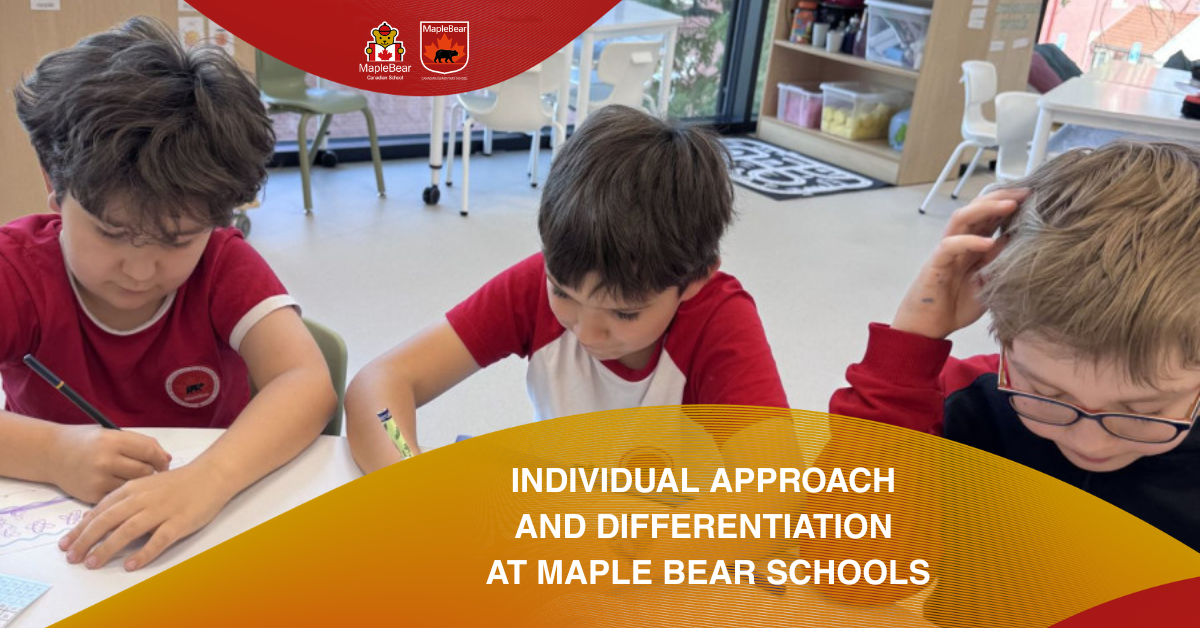
At Maple Bear, we see every classroom as a group of unique individuals. A teacher is therefore not simply someone who delivers information, but also a guide who observes how each child thinks, what comes naturally to them, and where they need additional support.
How does differentiation translate into everyday teaching?
- Different levels of challenge: Children can work on the same topic while completing tasks tailored to their current abilities. Some focus on strengthening the foundations, while others have the opportunity to explore a subject in greater depth.
- Different ways of learning: Children discover new things through hands-on activities, games, discussions, observation, experiments, and independent work.
- Individual pace: Children are given time to think, practise, and consolidate new knowledge. How quickly they complete a task is not the only measure of success.
- Ongoing support and feedback: Teachers monitor each child’s progress and help them recognise what they have already mastered and what they can continue to work on.
- Room for further development: Children who quickly master a particular area are offered new opportunities and challenges to help them continue growing.
Differentiation does not mean that every child needs an entirely different lesson. It means that even within the same classroom activity, each child can receive the support and opportunities that reflect their individual needs.
Why Is It Important to Respect Each Child’s Individual Pace?
Excessive pressure to perform and constant comparison with others can gradually undermine children’s motivation and self-confidence. If a child repeatedly feels they cannot keep up, they may begin to doubt their own abilities. On the other hand, a child who masters the material more quickly needs enough stimulation and new challenges to maintain their interest and curiosity. Respecting individual pace therefore does not mean slowing down the entire class. It means giving every child the opportunity to progress in a way that makes learning meaningful for them.
In Maple Bear classrooms, we focus primarily on individual progress. We look at how far each child has come, what new skills they have developed, and what steps will help them grow further. Our focus is not simply on whether they have achieved the same results as their classmates at the same time.
Another important part of this process is self-reflection. We encourage children to gradually learn how to recognise and talk about their achievements, identify areas they would like to improve, and take responsibility for their own learning.
The Teacher as a Guide Who Knows Their Students
For an individual approach to work effectively, teachers need to get to know their students well. This means paying attention not only to their results but also to the way they think, their interests, motivation, and responses to different learning situations.
Teacher collaboration also plays an important role. Every Maple Bear classroom has both a Czech-speaking and an English-speaking teacher, each leading their own lessons in their respective language. Together, they help ensure that education responds to students’ needs and supports their all-round development.
An individual approach is not a one-time teaching method or something that can simply be ticked off in a lesson plan. It is an everyday process of observation, communication, finding suitable strategies, and adapting teaching to the way children develop over time.
Success Is Not About Being First. It Is About Moving Forward.
We believe that the purpose of education is not to teach every child the same things at the same time. It is to create the conditions in which everyone can discover their abilities, develop independence, and build confidence in their own learning. Some children need more time, while others need greater challenges. Some learn best through hands-on activities, while others thrive through discussion or independent exploration. Every one of these approaches has its place in education.
That is why, at Maple Bear, we do not see different learning paces as an obstacle. We consider them a natural part of the learning process and an important reason why education should respond to the needs of every individual. Because true progress is not measured by how quickly a child reaches the finish line, but by how far they are able to grow.