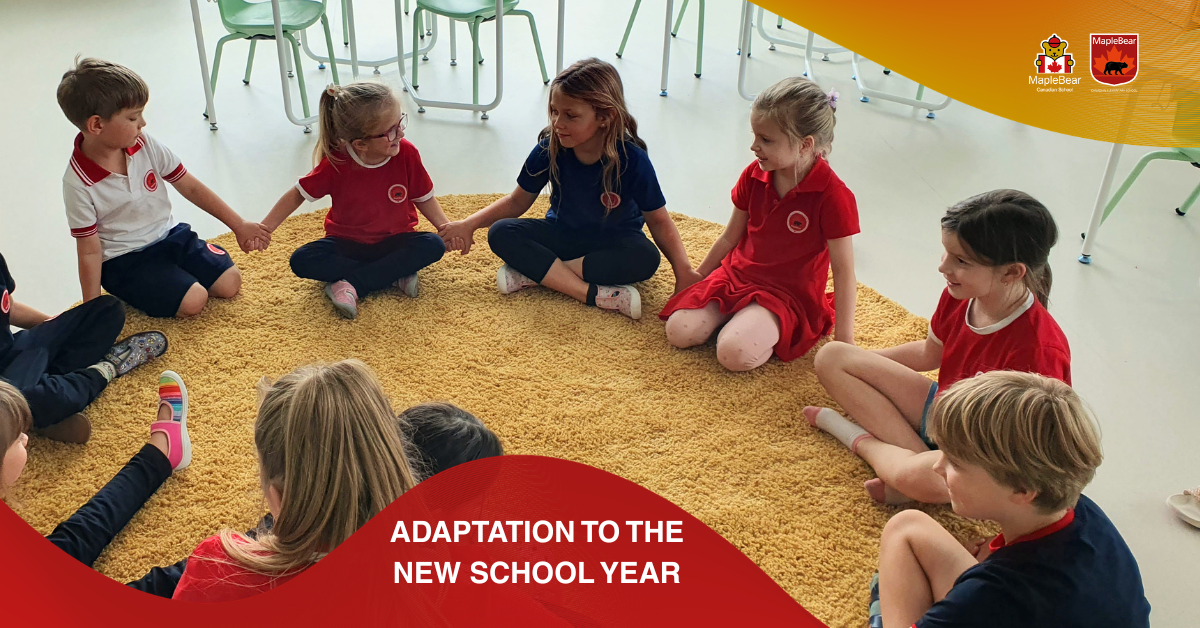
Returning to school or starting school for the first time is a big change after the summer holidays. After weeks filled with a more relaxed routine, travelling, new experiences and time with family, students return to a regular rhythm, early mornings, responsibilities and new challenges. And if they are entering a new class, a new environment or perhaps experiencing bilingual education for the first time, the beginning of the school year can be even more intense.
That is why at Maple Bear Olomouc, we see the first weeks of school primarily as a period of adaptation. We want every student to gradually find their place, become familiar with their new environment, understand their daily routines and, most importantly, develop a sense of safety and security. Let’s take a look at how we make this happen!
Adapting to a new environment starts with a sense of safety
Before students can fully focus on learning, they need to feel that they understand what is happening around them. That is why during the first days, we pay close attention not only to education, but also to familiarising students with the environment, rules and everyday routines of the school. Together, we go through the different parts of the school day, explain new routines and make space for questions. Students gradually learn where to find things, how the beginning of a lesson works, and when it is time for learning, rest, lunch or shared activities. Predictability is also important. When students know what to expect, they have more space to focus on new experiences and gradually develop their independence.
A new class community needs time
The beginning of the school year is also about relationships. Some students return to a familiar class community, while others meet new classmates and teachers. In both cases, the class community needs time to develop its own dynamic. That is why we encourage shared activities, collaboration in pairs and small groups, and situations where students can naturally get to know one another. It is not just about knowing the names of their classmates. We want students to gradually build relationships based on respect, collaboration and mutual trust. These relationships are an important part of creating an environment where students can feel comfortable and confident enough to try new things.
A bilingual environment is another new experience
For students at Maple Bear, adaptation also means returning to an environment where they naturally encounter both Czech and English. For some, bilingualism has already been part of their everyday lives for some time, while for others, the beginning of the school year can also be a period of getting used to hearing and using more English during regular lessons. We do not see English simply as a separate subject. Students encounter it while exploring science, mathematics, working on projects and communicating with teachers, classmates and the wider school team. Learning therefore takes place in context through the immersion method, with language becoming a natural tool for discovering the world. At the beginning of the school year, it is important to give everyone enough time. We do not expect everything to be perfect from day one. What matters more is that students gradually gain confidence, feel comfortable communicating and experience success.
A new environment can also be an opportunity
This year’s start to the school year is particularly special for us at Maple Bear Olomouc because our Grade 1 and Grade 2 students have moved into our new elementary school building. A new space brings plenty of exciting opportunities, but also new things to get used to. Where is the library? Where can I leave my things? Where is my classroom? How do the shared spaces work?
That is why we also use the first weeks to explore the school. We want students not only to become familiar with their new environment, but also to develop a connection with it and gradually feel that it truly belongs to them. We also design our classrooms with the idea that the environment is the “third teacher”. The space is designed to support curiosity, independence, collaboration and creativity, while helping students naturally take ownership of their own learning.
What can parents do?
Adaptation does not end at the school doors. The home environment and parents’ approach also play an important role. A few simple things can help:
Gradually return to a regular routine. Regular times for going to bed, waking up, eating and resting help both body and mind adjust to the school rhythm again.
Talk about school, but without pressure. Instead of questions such as “What did you do at school today?”, you could try “What surprised you today?” or “What did you enjoy today?”. Sometimes students need a little time to process all their new experiences first.
Make space for emotions. Excitement, nervousness, tiredness or uncertainty are all perfectly natural at the beginning of the school year. Everyone adapts at their own pace.
Support independence. Let your student prepare their school things, check their backpack or take part in planning their morning. Even small steps can strengthen their sense of competence.
Trust the process. Some students adapt within a few days, while others need several weeks. The important thing is to pay attention to their needs and give them enough time.
Every new beginning is also an opportunity
Adaptation is not something that needs to be “overcome” as quickly as possible. It is a natural part of starting a new chapter. During the first weeks, students build new routines, relationships and a sense of security that they can draw on throughout the school year.
At Maple Bear, we therefore want the beginning of the school year to be less about performance and more about gradually finding confidence in a new environment. When students know where they belong, what to expect and that they have people around them they can trust, they can approach what matters most with greater confidence – discovering, learning and growing.