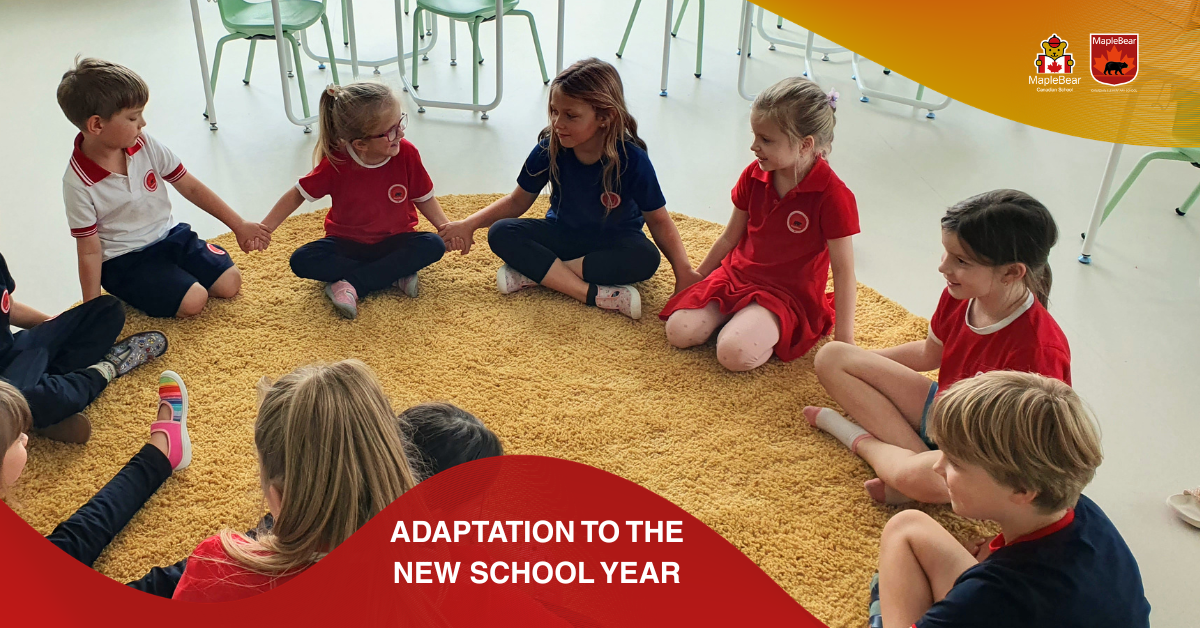
Starting at a bilingual preschool or school is a big step for both the child and the whole family. A new environment, new people, a different daily routine, and an additional language can bring joyful anticipation, but also uncertainty. All of this is a natural part of change. The good news is that with sensitive support, most children gradually adjust and begin to see the new environment as a safe and inspiring place. The first weeks are usually a time of getting to know one another, building trust, and finding a sense of security. Every child goes through adaptation at their own pace. Some join in almost immediately, while others need more time. It is not a race or a performance, but a process.Starting a bilingual kindergarten or school is a big step for the child and the whole family. A new environment, new people, a different daily routine and, in addition, a second language can bring joyful anticipation, but also uncertainty. All of this is a natural part of change. The good news is that most children gradually get used to sensitive support and begin to perceive the new environment as a safe and inspiring place. The first weeks are usually a period of getting to know each other, building trust and finding security. Each child goes through adaptation at their own pace. Some get involved almost immediately, others need more time. It’s not about the race or the performance, it’s about the process.
People often talk about whether a child is “ready” for preschool or school. In reality, this is not only about whether the child knows colors, can count, or can hold a pencil. True readiness is much broader. A child learns as a whole person—cognitive abilities, language, emotions, movement, social skills, and independence all develop together. Just as important as knowledge is whether the child can ask for help, wait their turn for a moment, cooperate with others, or manage a short separation from parents. Development also happens gradually and differently for each child. Age is not the only measure. Two children of the same age may respond in completely different ways—and both responses can be entirely normal.
In the first weeks, parents can expect a range of emotions. Crying, hesitation, or clinging to a parent during the morning drop-off are common. This does not mean the child is unhappy at preschool, but rather that they are processing change and need time. What helps most is a calm, brief, and confident goodbye. Long departures are often harder for a child than a clear and kind ritual. Many children are also more tired, sensitive, or irritable after returning home. A new environment is full of stimuli, and throughout the day the child is concentrating, observing, building relationships, learning rules, and responding to a foreign language. During this period, more calm time at home, enough sleep, and limiting other demanding activities can be very helpful. It is also common for a child to go to preschool smiling one day and refuse to get out of the car the next. Progress in adaptation is rarely linear.
A specific part of starting in a bilingual environment is the second language. Parents sometimes worry that it may be too demanding for the child. However, for young children, becoming familiar with a language happens naturally. They do not learn it as they would in a traditional classroom, but through everyday situations, play, and repetition. The language becomes part of daily life. Teachers use songs, rhymes, movement activities, pictures, visual aids, gestures, simple instructions, stories, and role play. A child does not need to speak immediately. At first, they often listen, observe, and store new expressions. Active use of the language comes gradually, when the child feels safe and confident.
A regular routine also plays a very important role in adaptation. Children benefit from predictability, because when they know what comes next, they feel safer. A repeated daily structure helps them orient themselves better and reduces the stress of the unknown. Morning circle time, snack time, outdoor play, rest, creative activities, or shared reading all give the child a sense of security. Home rituals are equally useful—for example, waking up and leaving at a similar time each day, a calm morning preparation, a short goodbye, shared time after returning home, or a regular evening routine.
Parents can also support their child through their own attitude. Children are very sensitive to the emotions of adults, and when a parent expresses trust and calmness, the child gains greater confidence. It also helps to listen without pressure and give the child space to share experiences at their own pace. Everyday home activities such as reading together, talking, singing, and playing are highly valuable. These are exactly the moments in which language, thinking, a relationship to learning, and emotional bonds develop. Encouraging independence in small daily tasks is also beneficial—for example, getting dressed, tidying toys, eating, or asking for help. It is important not to compare the child with others, because every child has their own pace and their own way of coping with a new situation.
Short-term crying, tiredness, or uncertainty are a normal part of adaptation. However, if difficulties intensify over a long period, the child strongly refuses food or sleep, repeated physical complaints appear, or they are unable to make contact even after more time has passed, it is appropriate to openly discuss the situation with the teachers. Working together to find a solution is usually the most effective approach.
Successful adaptation is built above all on trust and open communication between the family and the school. When teachers know the child’s needs, habits, worries, and strengths, they can support them more effectively. And when parents know what happens during the day, they feel calmer as well. The first weeks in a bilingual preschool or school are a period of change, growth, and new experiences. They may bring tears as well as joy, tiredness as well as excitement. With patience, kind guidance, a regular routine, and good cooperation between parents and teachers, the child will gradually gain confidence, build relationships, and begin to explore the new environment with joy. And that positive first experience can become a strong foundation for their future relationship with education and with foreign languages.